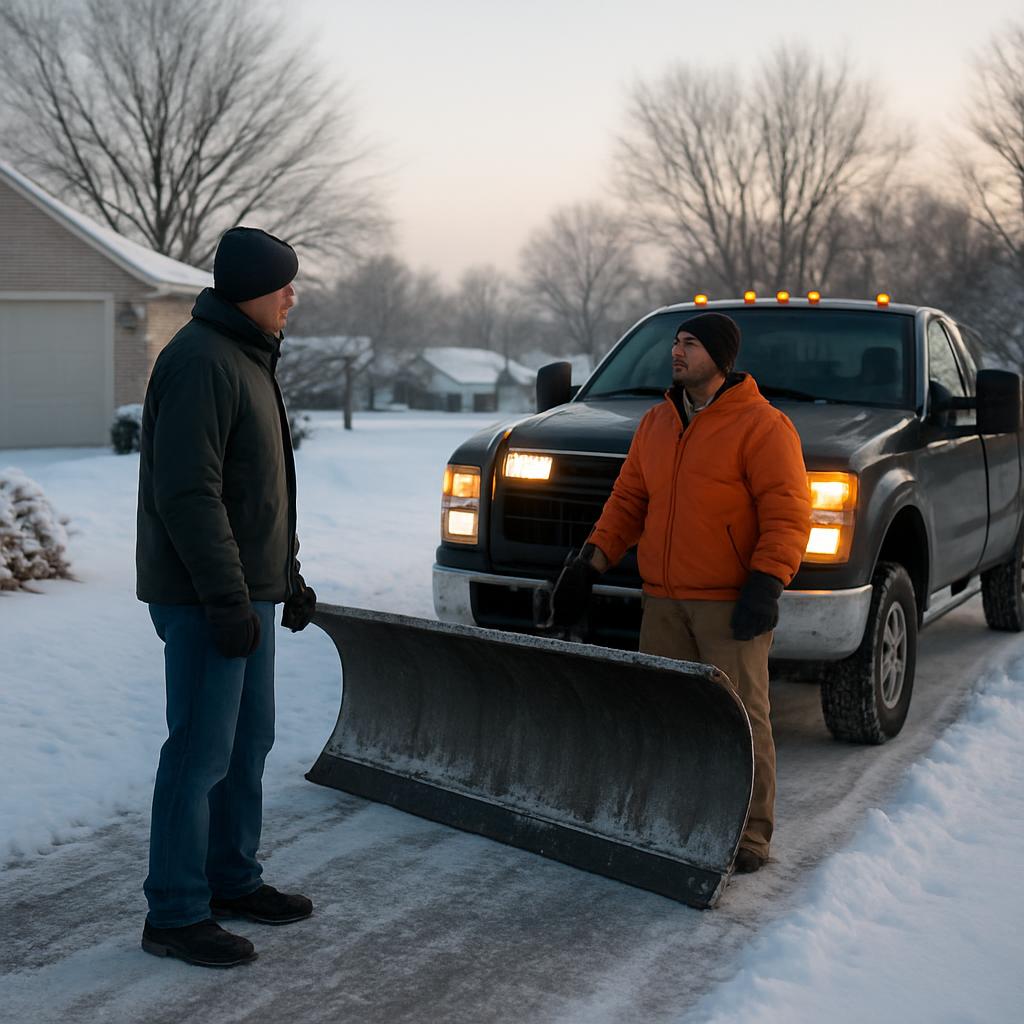
The first heavy snowfall of the season is when most homeowners discover what their snow removal contract actually says. A plow that arrives at noon instead of before work, a bill for a "second push" nobody mentioned, or a cracked driveway edge with no clear owner can turn a modest seasonal fee into a frustrating winter. Most of those disputes trace back to the same thing: terms that were agreed out loud and never written down.
Snow removal is usually sold in one of three ways. A seasonal contract charges a flat fee for the whole winter, however much snow falls. A per-push or per-visit arrangement charges each time the crew clears the property. A per-inch model scales the price with the size of the storm. Each can be the right choice for a particular household, but none of them works well if the details are left vague.
The trigger depth
Every contract should state how much snow has to fall before the crew comes out. Common trigger depths are one, two or three inches, and the difference matters. A two-inch trigger can mean a lighter storm is left for the homeowner to deal with, while a one-inch trigger usually costs more because the crew visits more often. The contract should also say whether the trigger is measured at the property, at a local weather station, or by the contractor's own judgment.
When the crew will arrive
"After the storm" is not a time. A useful contract says whether the driveway will be cleared during a long snowfall or only once it stops, and gives a target window, such as before 7 a.m. on weekdays. Homeowners who leave early for work, or who have a family member with medical appointments, should say so before signing and ask for that priority to be written into the agreement rather than promised on the phone.
What the price covers
The written price should list exactly what is included: the driveway, the sidewalk in front of the house, the walkway to the door, steps, and the plow ridge the city leaves at the end of the driveway. Salt or ice melt is often an extra charge, and so are return visits for drifting snow. If the contract is seasonal, it should state whether there is a cap on the number of visits, and what happens in a winter with almost no snow or a record-breaking one.
Some contractors now publish this detail themselves. KG Landscape, a Minnesota landscaping company, sets out in a guide what its seasonal contracts include and points out that a "seasonal contract" describes how the service is billed, not how good it is. In Minnesota, the company notes, seasonal coverage typically runs from November through April. A contractor that puts its terms in writing before anyone asks makes the comparison much easier.
Damage and markers
Plows and snow blowers can scrape lawns, chip curbs and hit landscape lighting hidden under the snow. Before the season starts, homeowners can walk the property with the contractor, agree where driveway markers will go and point out anything fragile near the edges. The contract should say who pays if something is damaged and how a claim is reported. Asking for proof of liability insurance is a reasonable request for any crew operating heavy equipment on private property.
Payment and cancellation
Seasonal contracts are often paid up front or in two installments. Paying in full before the first snowfall is common, but it leaves the homeowner with little leverage if the service is poor in January. Splitting the payment, or paying by credit card rather than cash, offers more protection. The agreement should also explain whether either side can cancel mid-season and whether any part of the fee is refunded.
Checking the company first
A short background check takes only a few minutes. Searching the company's name alongside words such as "complaint" or "review" is a start, and the Better Business Bureau lets homeowners look up a business and see whether complaints have been filed and answered. A clean record is not a guarantee, and a single complaint is not proof of a bad operator, but a pattern of unresolved problems is worth taking seriously. Neighbors who used the same crew last winter are often the most useful reference of all.
Some states and cities also require snow removal businesses to hold a general business license, and a few require specific registration for commercial plowing. A local consumer protection office can say what applies in a given area.
A one-page check before signing
The simplest approach is to write five lines on a single page before agreeing to anything: the trigger depth, the arrival window, what the price covers, who pays for damage, and how payment and cancellation work. If any line is still blank after talking to the contractor, that is the question to ask before signing. A crew that answers clearly in November is far more likely to show up when the driveway is buried in February.
Dana Whitfield is a freelance writer covering home maintenance and household money decisions.