
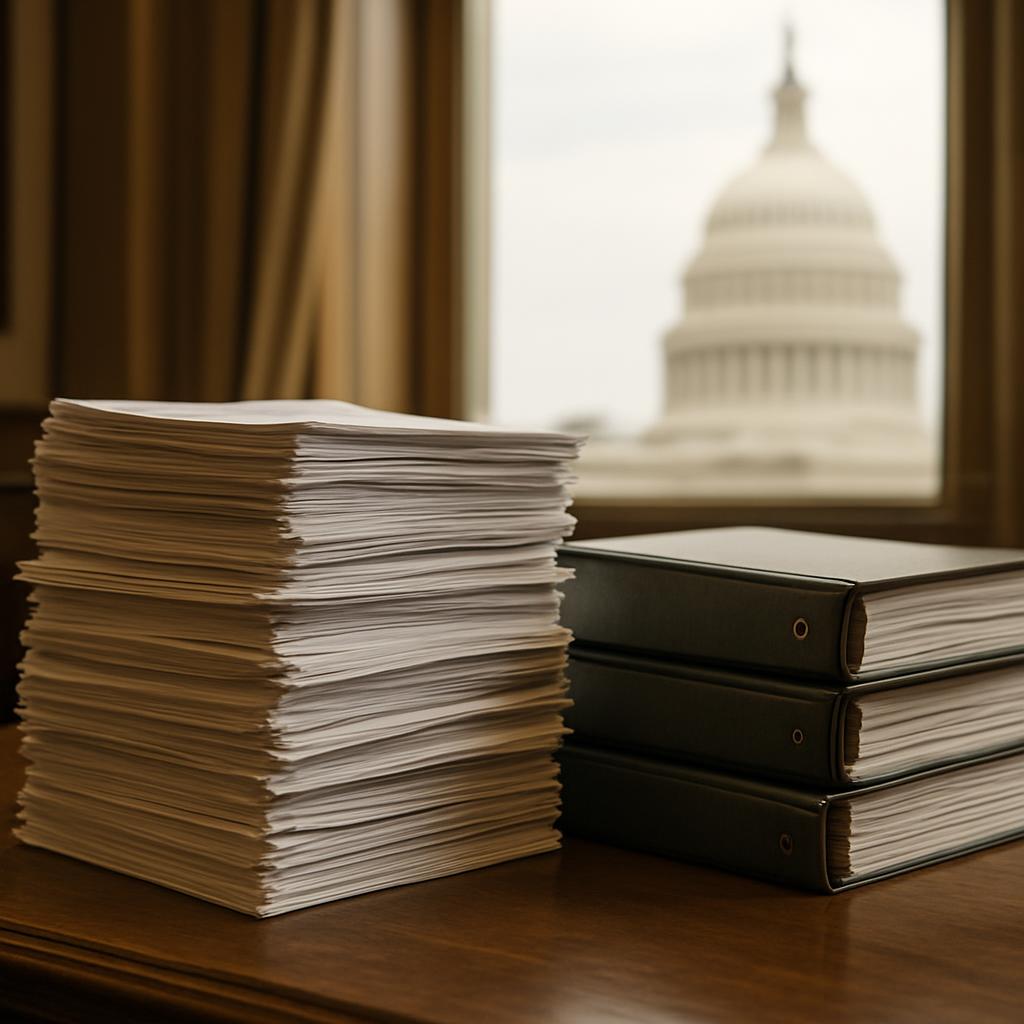
The federal budget works through a yearly cycle: the president sends Congress a spending request, lawmakers write and pass bills that actually set spending levels, and federal agencies can only spend money that Congress has approved in law. This cycle runs on a fiscal year that starts October 1 and ends September 30, which is why fall in Washington is almost always budget season. Few recent cycles have gone smoothly, and the process has become a regular source of shutdown threats and last-minute deals.
Key takeaways
- The federal budget runs on a fiscal year from October 1 to September 30, not the calendar year.
- The Constitution gives Congress the power of the purse, so no money can be spent without a law passing both chambers and reaching the president.
- Discretionary spending is decided fresh each year; mandatory spending like Social Security and Medicare runs automatically under existing law.
- The debt ceiling is a separate limit on borrowing to pay for spending Congress already approved, not a vote on new spending.
- Congress frequently misses its own deadlines, relying on stopgap bills or risking shutdowns, and the 2026 situation can still change before year's end.
Is the 2026 budget already approved?
Only parts of it, and the full picture keeps shifting, so readers should treat this as a snapshot rather than a final answer. Congress rarely finishes all twelve of its annual spending bills on time, and recent years have relied heavily on short-term extensions called continuing resolutions to keep agencies open while lawmakers keep negotiating.
For the 2026 fiscal year, some appropriations bills moved through committee and even passed one chamber, but others stalled over disputes on spending levels, policy riders, and election-year politics. That pattern matches most of the last two decades; a government that finishes all its spending bills by October 1 is now the exception, not the rule.
For a detailed, regularly updated look at exactly which parts of this year's budget have passed and which remain stuck, see this breakdown of the 2026 federal budget. Because the situation changes week to week, readers should check that source or official congressional records for the latest status rather than relying on any single summary for too long.
Shutdown threats are a direct byproduct of this unfinished process, and what happens when funding lapses has become a recurring December storyline in Washington.
What is the debt ceiling?
The debt ceiling is a legal cap on how much money the federal government can borrow to pay bills it has already incurred. It is not a vote on new spending; it is a separate fight over whether the Treasury can keep issuing debt to cover spending Congress already approved in past budgets.
Congress created the modern debt limit in 1917 to simplify wartime borrowing, and lawmakers have raised or suspended it well over 100 times since. Because hitting the ceiling risks a first-ever default on U.S. debt, these votes have become political leverage points rather than routine bookkeeping.
Two fights stand out as examples. In 2011, a standoff over raising the limit pushed the country close to default and led to a downgrade of the U.S. credit rating by one major agency. In 2023, Congress suspended the ceiling as part of a broader spending deal only after weeks of brinkmanship.
The key distinction to remember: the budget process decides how much the government plans to spend, while the debt ceiling decides whether the Treasury is allowed to borrow the money needed to cover spending already written into law. Raising the debt ceiling does not authorize a single new dollar of spending.
What is discretionary spending?
Discretionary spending is the portion of the federal budget that Congress must approve every single year through the appropriations process. It covers things like defense, the FBI, national parks, highway funding, and education grants, and it typically makes up roughly a quarter to a third of total federal spending.
The rest of the budget is mandatory spending, which runs on autopilot under existing laws rather than annual votes. Social Security, Medicare, and Medicaid are the biggest examples, and they grow or shrink based on formulas and eligibility rules rather than a yearly congressional decision. Interest payments on the national debt are also mandatory, since the government is legally required to pay bondholders.
This split matters because it explains where budget fights actually happen. Lawmakers argue over discretionary spending every year because they have direct control over it, while mandatory programs mostly stay out of the annual appropriations drama unless Congress passes separate legislation to change the underlying law.
- Discretionary: defense, education, NASA, national parks, foreign aid, FBI, set annually
- Mandatory: Social Security, Medicare, Medicaid, unemployment insurance, runs under standing law
- Interest on the debt: mandatory, grows automatically as borrowing and interest rates rise
How does the federal budget process actually work, step by step?
The process follows a set legal sequence, even though lawmakers frequently miss the deadlines built into it. Each step involves a different part of government and a different kind of political pressure.
- The president submits a budget request to Congress, usually in February, laying out spending and revenue priorities for the coming fiscal year.
- The House and Senate Budget Committees draft a budget resolution, which sets overall spending targets but is not signed by the president and does not have the force of law.
- The House and Senate Appropriations Committees divide discretionary spending into twelve separate bills, covering areas like defense, labor, and transportation.
- Subcommittees hold hearings, question agency officials, and mark up each bill before sending it to the full Appropriations Committee and then the floor.
- Both the House and Senate must pass all twelve bills, then reconcile any differences between their versions.
- The president signs the finished bills into law, or vetoes them and sends them back for changes.
- If Congress cannot finish in time, lawmakers pass a continuing resolution to keep agencies funded at existing levels temporarily.
- The new fiscal year begins October 1, using whatever combination of signed bills and continuing resolutions exists at that point.
In practice, Congress almost never finishes all twelve bills by October 1. Lawmakers instead bundle several bills into a single large package, known as an omnibus, or rely on a continuing resolution that can last weeks or months. The congressional calendar plays a direct role here, since recesses and election-year schedules leave fewer working days to finish the job.
Congress has also used a special procedure called reconciliation to pass certain budget-related bills with a simple majority in the Senate, avoiding the 60-vote threshold normally needed to end debate. This tool has been used for major tax and health care legislation in past years, because it is limited to provisions that directly affect spending, revenue, or the debt.
Who holds the power at each step of the budget process?
The Constitution assigns spending power to Congress, but several different offices and committees share real authority along the way. No single person or chamber controls the whole process alone.
| Step | Who holds the power |
|---|---|
| Budget request | President and the Office of Management and Budget |
| Budget resolution | House and Senate Budget Committees |
| Writing spending bills | House and Senate Appropriations Committees |
| Passing bills | Full House and Senate, simple majority needed |
| Avoiding a filibuster | Reconciliation process, Senate only, limited uses |
| Final sign-off | President, who can sign or veto |
| Stopgap funding | Congress, through continuing resolutions |
This shared structure is why budget fights so often become standoffs. A president from one party and a Congress controlled partly or fully by another can disagree for months, and because every appropriations bill needs to pass both chambers, a handful of senators or a narrow House majority can hold up funding for an entire agency or department.
What happens if Congress misses the budget deadline?
If Congress misses its October 1 deadline without passing a continuing resolution, agencies that depend on expired funding have to shut down nonessential operations. This is the mechanism behind every government shutdown, and it has happened repeatedly in recent decades.
The longest shutdown in U.S. history ran 35 days from December 2018 into January 2019, driven by a dispute over border wall funding. An earlier 16-day shutdown in October 2013 stemmed from a fight over health care law funding. Both ended only after Congress passed funding legislation the president agreed to sign.
Short-term continuing resolutions are far more common than full shutdowns, since lawmakers generally prefer to buy time rather than let funding lapse entirely. Even so, repeated stopgaps create uncertainty for agencies trying to plan contracts, hiring, and programs months in advance. Delays like these have become a familiar feature of recent budget cycles rather than a rare exception.
As of November 2026, lawmakers are again working against the clock on unfinished appropriations bills, and that status can shift quickly with any new vote or deal, so readers should check current coverage before assuming any outcome is final.
What does the federal budget process mean for ordinary people?
The budget process directly shapes paychecks, benefits, and public services, even when the fights happen far from most people's daily lives. When agencies run out of approved funding, federal workers can be furloughed or asked to work without pay until a deal is reached, and contractors who rely on federal money often see projects frozen.
Mandatory programs like Social Security and Medicare generally keep paying out during a funding lapse because their money comes from separate, ongoing legal authority rather than annual appropriations. But discretionary services, such as national park operations, food safety inspections, and some small business loan processing, can slow down or pause during a shutdown.
The debt ceiling fight carries different stakes. If the Treasury ever hit its limit and could not borrow to cover bills already owed, the government could risk missing payments on obligations ranging from bondholders to federal contractors, a scenario that has never fully happened but has come close, most notably in 2011 and 2023.
Even when there is no shutdown or default, the budget process still matters because it sets the actual dollar amounts behind programs people depend on, from school funding formulas to highway repair grants, making it one of the most consequential and least understood parts of how Washington runs.
Frequently asked questions
What's the difference between a budget resolution and an appropriations bill?
A budget resolution is a blueprint that sets overall spending and revenue targets, but it is not signed by the president and doesn't fund anything by itself. Appropriations bills are the actual laws that provide money to specific agencies and programs, and they require the president's signature to take effect.
How much does the federal government spend each year?
Total federal spending runs into the trillions of dollars annually, split between discretionary programs Congress sets yearly and mandatory programs that run on existing law. Exact figures change each year, so readers should check current Congressional Budget Office or Treasury reports for the latest numbers.
What is reconciliation and how does it bypass the filibuster?
Reconciliation is a special Senate procedure that allows certain budget-related bills to pass with a simple majority instead of the 60 votes normally needed to end debate. It can only be used for provisions that directly affect federal spending, revenue, or the debt, which limits what can be included.
Can the president refuse to spend money Congress has approved?
Generally no. A 1974 law limits the president's ability to withhold, or 'impound,' funds Congress has already appropriated, though disputes over the limits of that power still surface in Washington from time to time.
What's the difference between the deficit and the national debt?
The deficit is the gap between what the government spends and what it collects in a single year, while the national debt is the total accumulated borrowing built up over many years of deficits. Raising the debt ceiling addresses the second problem, not the first.