
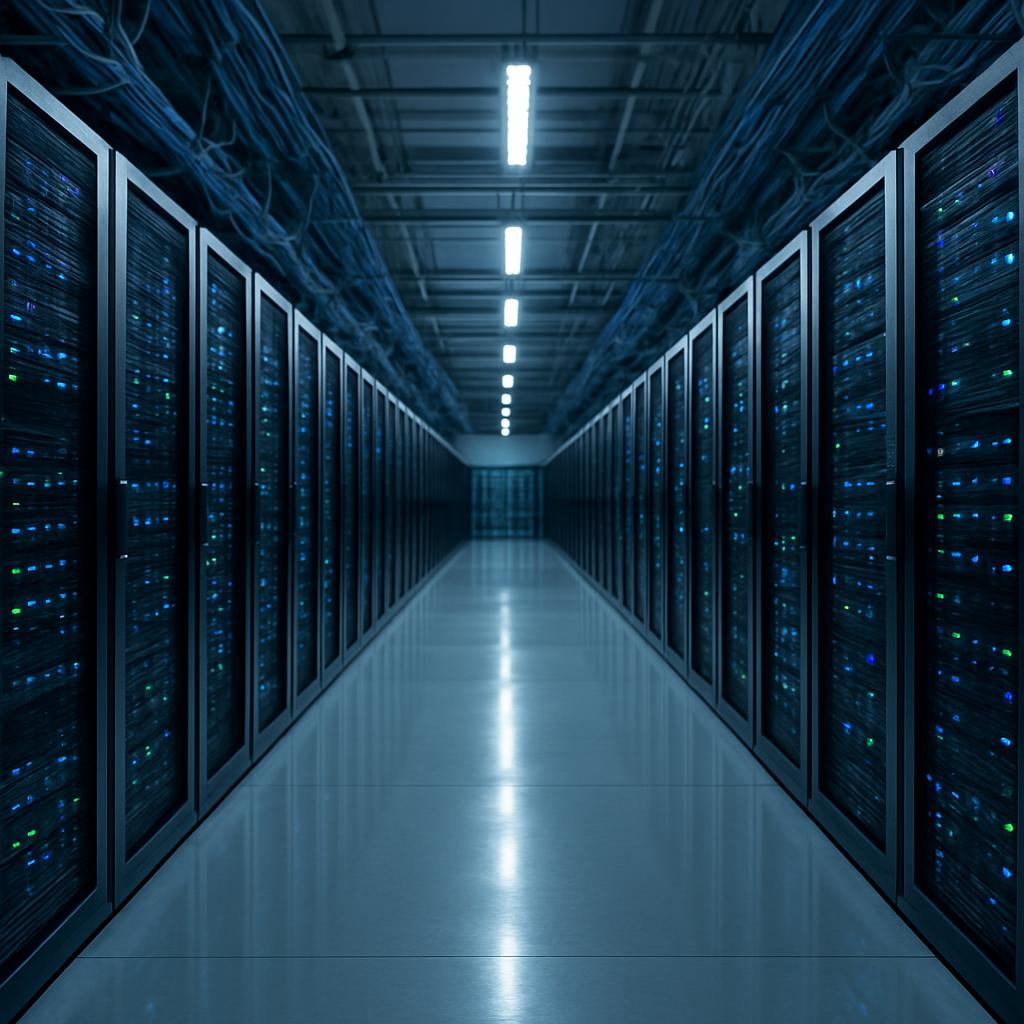
The main types of data centers are enterprise (company-owned), colocation (shared rented space), hyperscale (massive cloud-provider campuses), edge (small, local facilities) and managed or cloud data centers run entirely by a third party. Every type does the same basic job, housing the servers, storage and networking equipment that keep websites, apps and company systems running, but they differ hugely in size, ownership and who is responsible for keeping the lights on. Understanding the differences matters because the choice affects cost, speed, reliability and who controls the data inside.
Key takeaways
- Data centers come in five broad types: enterprise, colocation, hyperscale, edge and managed cloud facilities
- Hyperscale data centers, run by companies like Amazon, Microsoft and Google, can cover millions of square feet and house tens of thousands of servers
- Cloud storage simply means your files live on servers inside one of these data centers, usually copied across several locations for safety
- Building a 100,000 sq ft data center typically costs tens of millions of dollars once power, cooling and networking are included
- AI workloads are pushing data centers toward denser racks, liquid cooling and more power-hungry designs
What types of data centers are there?
There are five main types of data centers, and they are usually grouped by who owns them and how big they are, as explained by IBM's overview of data center infrastructure.
An enterprise data center is built and run by a single company for its own use, often inside or next to its offices. A colocation data center is owned by a specialist provider that rents out rack space, power and cooling to many different businesses under one roof. A hyperscale data center is a huge facility, usually owned by a cloud giant, built to support millions of users and massive workloads like AI training. An edge data center is small and placed close to where people actually use data, such as a city center or a cell tower site, to cut delay. A managed services or cloud data center is fully operated by a third-party provider that sells computing power as a service rather than physical space.
- Enterprise: owned and run by one company for its own systems
- Colocation: shared building where many companies rent space and equipment
- Hyperscale: huge, single-owner facilities built for cloud and AI scale
- Edge: small, local sites built for low-delay applications
- Managed/cloud: fully outsourced computing sold as a service
These categories overlap in practice. A single company might rent colocation space in one city, use a hyperscale cloud provider for most of its workloads, and keep a small edge server for a factory floor. The right mix depends on budget, how much control a business wants, and how fast its applications need to respond.
How is data stored in the cloud?
Cloud storage means your files, photos or company records are saved on physical servers inside a data center, not on your own device. When you upload a photo to a cloud app, it travels over the internet to a data center, where it is written onto hard drives or solid-state drives inside server racks.
To prevent loss, cloud providers almost always keep more than one copy of each file, often in different buildings or even different regions, so a single hardware failure or fire does not destroy the only copy. This process, called replication, happens automatically and invisibly to the user. Large providers also spread data across multiple drives using a method called striping, which both speeds up access and adds another layer of protection if one drive fails. Cloud computing as a whole relies on this network of data centers working together behind the scenes.
Security and access controls sit on top of this storage layer. Data is usually encrypted both while it travels over the internet and while it sits on the drive, and only accounts with the right permissions can open it. This is also why two-factor authentication matters so much for cloud accounts: it is often the main barrier between a stolen password and someone reading your stored files.
What does the inside of a data center look like?
Inside, most data centers look like long rows of metal cabinets, called racks, packed with stacked servers, blinking lights and thick bundles of cable running along the ceiling or under a raised floor. The rooms are kept cold and dry, often around 18 to 27 degrees Celsius, because heat is the biggest enemy of running hardware.
A typical facility is divided into zones: a server hall with the racks, a network room where traffic connects to outside internet lines, a power room with backup batteries and generators, and a cooling plant with large chillers or fans. Larger buildings also have strict physical security, including fenced perimeters, badge-controlled doors, cameras and sometimes biometric locks, since a single unassuming building can hold the systems millions of people rely on every day.
Despite running some of the world's most advanced technology, data centers are deliberately plain from the outside. Many have no company signage, few windows, and look more like warehouses than offices, partly for security and partly because people rarely need to visit once the equipment is installed.
Noise is another defining feature. Rows of fans and cooling units create a constant, loud hum, which is why staff working on the server floor usually wear hearing protection and most day-to-day monitoring happens from a quieter control room nearby.
How much does it cost to build a 100,000 sq ft data center?
Building a 100,000 square foot data center generally costs tens of millions of dollars, with the exact figure depending heavily on location, power capacity and how much high-end cooling and backup equipment is installed. Industry estimates commonly put construction costs somewhere in the range of several hundred to over a thousand dollars per square foot once specialized electrical and cooling systems are included, so readers should check current industry reports for up-to-date figures before relying on a specific number.
Land and the building shell are usually the smallest part of the bill. The bigger costs come from electrical infrastructure, backup generators, uninterruptible power supplies, and industrial cooling systems, all of which must be sized to handle thousands of servers running at once without overheating or losing power. Networking equipment and the servers themselves add further cost on top of the building.
Running costs matter just as much as construction. Electricity is usually the largest ongoing expense, since servers and cooling systems draw power around the clock, which is part of why data center operators increasingly negotiate long-term energy contracts and locate new sites near cheap or reliable power sources, including renewable energy projects.
How do data centers work step by step?
A data center works by combining power, cooling, hardware and networking into one continuous system that keeps servers running without interruption.
- Electricity arrives from the local grid and is backed up by batteries and diesel or gas generators in case of an outage
- Power is distributed to rows of server racks through protected electrical systems
- Servers inside the racks process and store data using processors, memory and drives
- Cooling systems remove the heat generated by thousands of running servers
- Network switches and fiber connections send and receive data to and from the internet
- Monitoring software and staff watch for hardware failures, overheating or security issues
- Backup systems automatically take over if any part of the chain fails
This chain has to work continuously, because even a short power or cooling failure can shut down thousands of websites or apps at once. That is why large facilities build in redundancy at almost every step, often running duplicate power paths and cooling units so that one failure does not bring the whole building down.
How do the main data center types compare?
Each type of data center trades off ownership, scale and cost in a different way, which is why most large organizations end up using more than one type.
| Type | Typical owner | Typical size | Best suited for |
|---|---|---|---|
| Enterprise | Single company | Small to medium | Businesses wanting full control over their own systems |
| Colocation | Specialist landlord | Medium to large | Companies that want their own hardware without owning a building |
| Hyperscale | Cloud giant (e.g. Amazon, Microsoft, Google) | Very large, often 100,000+ sq ft | Mass-market cloud services and AI workloads |
| Edge | Telecom or cloud provider | Small, local | Low-delay applications like gaming or factory sensors |
| Managed/cloud | Third-party provider | Varies | Businesses that want computing as a service, not physical equipment |
Hyperscale facilities are the ones most people picture when they think of a modern data center, since companies behind major cloud platforms build campuses that can house tens of thousands of servers and draw as much power as a small city. Edge facilities sit at the opposite end of the scale, sometimes fitting inside a single cabinet near a cell tower, built purely to shorten the distance data has to travel.
What are the pros and cons of each data center type?
Each type offers a different balance of control, cost and convenience, so the best choice depends on what a business needs most.
- Enterprise: full control and customization, but high upfront cost and the company bears all maintenance
- Colocation: lower cost than owning a building, shared security and cooling, but less flexibility than a private facility
- Hyperscale: massive scale and low per-unit cost, but customers have little say in how the physical infrastructure is run
- Edge: very fast response times for nearby users, but limited capacity and higher cost per unit of computing
- Managed/cloud: no hardware to buy or maintain, fast to scale up or down, but less direct control over where data physically sits
Security and compliance requirements often decide the matter. Industries with strict data rules, such as banking or healthcare, sometimes still prefer enterprise or colocation setups because they can specify exactly where data is stored and who can access the building, something that is harder to pin down with large shared cloud platforms.
What's next for data centers?
Rising demand from AI is the biggest force reshaping data centers right now, pushing operators to build denser server racks that need far more power and cooling than older facilities were designed for. Many new builds now use liquid cooling, which circulates coolant directly near chips instead of relying only on air conditioning, because it handles heat far more efficiently.
This growth is tightly linked to the hardware inside the buildings. The boom in semiconductor sales driven by AI demand is a direct result of data centers buying enormous numbers of specialized chips to train and run AI models.
Energy supply is becoming just as important as chip supply. Because data centers already use a significant and growing share of electricity in some regions, several major operators are signing deals for nuclear, solar and wind power, or building facilities next to power plants to secure a steady supply. Expect continued growth in edge locations too, as more devices, sensors and AI applications demand faster local processing rather than relying solely on distant hyperscale campuses.
Frequently asked questions
What is a hyperscale data center exactly?
A hyperscale data center is an extremely large facility, typically built and run by a major cloud or tech company, designed to support millions of users and huge computing workloads. These sites can cover well over 100,000 square feet and house tens of thousands of servers working together.
How much electricity do data centers use?
Data centers use a large and growing share of electricity worldwide because servers and cooling systems run continuously. Exact figures vary by country and change quickly as AI demand grows, so readers should check current energy agency reports for the latest numbers.
Is my data safe in a data center?
Reputable data centers use strong physical security, encryption and redundant systems to protect stored data, but no system is completely risk-free. Users can add protection on their end by enabling strong passwords and two-factor authentication on cloud accounts.
What is an edge data center used for?
An edge data center is a small facility placed close to where data is actually used, such as near a city or cell tower, to reduce delay. It is commonly used for things like video streaming, online gaming and factory automation, where even small delays matter.
Are data centers bad for the environment?
Data centers consume significant electricity and water for cooling, which has raised environmental concerns, especially as AI increases demand. Many operators are responding by investing in renewable energy, more efficient cooling and better hardware utilization, though the overall environmental impact depends heavily on each facility's energy source.
Can a small business afford its own data center?
Building a private data center is usually too expensive for small businesses, which is why most rent space in a colocation facility or simply use cloud services instead. This gives them access to reliable infrastructure without the huge upfront construction and maintenance costs.