The jobs least likely to be replaced by AI are those that depend on physical work in unpredictable settings, face-to-face care, and human judgment and trust: nurses, electricians and plumbers, teachers, therapists and social workers, and skilled managers. Data from 2026 shows AI has not caused a broad rise in unemployment, but it is already shrinking entry-level openings in jobs such as programming, customer service and data entry.
Key takeaways
- There is no sign yet of AI-driven mass unemployment: workers in the most AI-exposed jobs have not seen a systematic rise in unemployment since late 2022.
- The clearest effect is on young workers: employment for 22- to 25-year-olds in highly exposed jobs is running about 19% below its expected trend, according to Stanford research using payroll data through June 2026.
- Jobs combining physical skill, human contact and accountability, such as nursing, the skilled trades and teaching, are the most resistant.
- Computer programming and data entry are among the most exposed, with AI already able to handle a large share of their tasks.
- About half of U.S. adults now use AI chatbots, led by ChatGPT, Gemini, Copilot and Meta AI.
Which jobs is AI unlikely to replace?
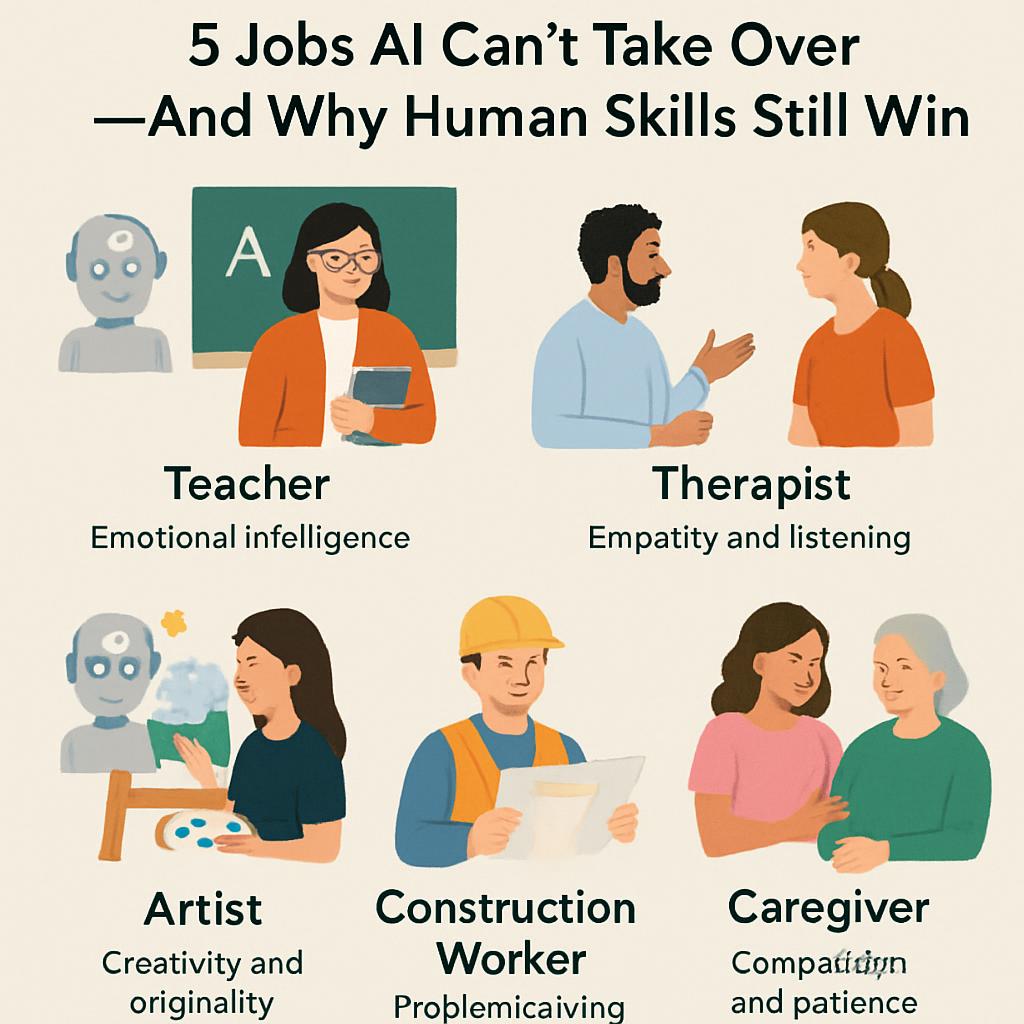
No job is completely untouched, but these five groups are consistently rated among the most resistant to automation, because the core of the work is something current AI cannot do:
- Nurses and other hands-on health workers. AI can read scans and flag risks, but it cannot turn a patient, insert an IV, notice that someone seems frightened, or take responsibility for care decisions at the bedside. Nurse practitioners and home health aides are among the occupations the Bureau of Labor Statistics projects to grow fastest, according to its fastest-growing occupations list.
- Skilled trades: electricians, plumbers, HVAC technicians. Every job site is different, the work is physical, and mistakes are dangerous. Robots that can work safely in a cramped, unfamiliar basement are a long way off, and demand for electricians is rising with data center construction.
- Teachers, especially of young children. AI tutors can help with practice and explanation, but classroom management, motivation, safeguarding and reading a child's mood remain human work.
- Therapists, counselors and social workers. These roles rest on trust, confidentiality and judgment in emotionally complex situations, and people generally want a human accountable for them.
- Managers and leaders who make judgment calls. Negotiating, hiring, resolving conflicts and taking responsibility for decisions are hard to hand to software, even if AI drafts the reports they rely on.
Other resistant roles include emergency responders, physical therapists, chefs and cooks, construction workers, and many care jobs. Anthropic's 2026 analysis of real AI usage found that about 30% of workers, including cooks, lifeguards and bartenders, have essentially none of their tasks covered by current AI use, according to a roundup of 2026 AI job statistics.
Which jobs are most at risk from AI?
The most exposed jobs are those built mainly on routine work with text, numbers or code done at a desk. The same roundup reports that observed AI use already covers about 75% of a computer programmer's tasks and 67% of a data entry keyer's.
| More exposed to AI | Less exposed to AI |
|---|---|
| Computer programmers, especially junior roles | Electricians, plumbers and HVAC technicians |
| Data entry and administrative assistants | Registered nurses and home health aides |
| Customer service representatives | Teachers and childcare workers |
| Translators and some writing and editing roles | Therapists, counselors and social workers |
| Bookkeeping and some paralegal tasks | Construction trades and emergency responders |
"Exposed" does not automatically mean "replaced." In many exposed jobs AI takes over some tasks while workers spend more time on the rest, and some exposed roles pay more as a result. The bigger risk is fewer people being hired to do the same amount of work.
Is AI actually taking jobs in 2026?
The honest answer is: a little, in specific places, but not across the economy. Three findings from 2026 sum up the evidence:
- No broad unemployment rise. Anthropic's March 2026 study found no systematic increase in unemployment for workers in the most AI-exposed occupations since late 2022.
- Young workers are feeling it. Stanford's Digital Economy Lab, using ADP payroll data through June 2026, found employment for 22- to 25-year-olds in the most exposed jobs about 19% below where it would have been had it kept pace with less-exposed peers, as summarized in this review of entry-level hiring data. Experienced workers in the same jobs show no gap.
- Companies are citing AI in layoffs. Employers attributed about 116,000 announced U.S. job cuts to AI from January through August 2026, roughly a fifth of all announced cuts, according to outplacement firm Challenger, Gray & Christmas.
Researchers still disagree about how much of the entry-level slowdown is caused by AI and how much by other factors, including higher interest rates, cautious hiring after the pandemic boom, and remote work making junior staff harder to train. Most employers surveyed say they are changing tasks within jobs rather than eliminating entry-level roles outright.
What is artificial intelligence, in simple words?
Artificial intelligence is software that can perform tasks that normally need human intelligence, such as understanding language, recognizing images, making predictions or writing text. Modern AI systems learn patterns from very large amounts of data instead of following rules written line by line by programmers. Our explainer on machine learning covers how that learning works.
The AI tools most people now use are large language models, which generate text by predicting likely next words based on what they learned in training. They run on huge numbers of specialized semiconductor chips in data centers, most of them rented through cloud computing platforms.
What are the four types of AI?
A common textbook framework sorts AI into four types by capability. Only the first two exist today:
- Reactive machines: respond to inputs with no memory of the past, such as IBM's Deep Blue chess computer.
- Limited memory: learn from data and recent context. Chatbots, self-driving systems and recommendation engines fall here.
- Theory of mind: AI that would genuinely understand people's beliefs and emotions. This is still a research goal.
- Self-aware AI: machines with their own consciousness. This is hypothetical.
Another common split is narrow AI, built for specific tasks, versus artificial general intelligence, a still-theoretical system that could match humans across most tasks.
What are the most used AI tools?
About half of U.S. adults (49%) now use AI chatbots, and ChatGPT is by far the most used, according to a February 2026 Pew Research Center survey:
| AI chatbot | Share of U.S. adults who use it |
|---|---|
| ChatGPT (OpenAI) | 44% |
| Gemini (Google) | 24% |
| Copilot (Microsoft) | 17% |
| Meta AI | 14% |
| Grok (xAI) | 8% |
| Claude (Anthropic) | 6% |
So the top three are ChatGPT, Gemini and Copilot. Globally, OpenAI has said ChatGPT reached around a billion weekly users in 2026, and Meta AI reaches very large numbers of people because it is built into WhatsApp, Instagram and Facebook.
What did Bill Gates warn about AI?
Bill Gates has said in interviews that AI will make expertise that is scarce today, such as good medical advice and high-quality tutoring, cheap and widely available within about a decade, and that humans will eventually not be needed "for most things." He has also said some work will stay human because people will want it to, and he has repeatedly urged governments to plan for job disruption rather than assume it will sort itself out.
His view sits between the extremes: AI as a transformative tool that will change a large share of jobs, not an overnight replacement for workers.
Who is the father of AI?
John McCarthy is usually called the father of artificial intelligence. He coined the term in 1955 for a proposal that led to the 1956 Dartmouth workshop, which launched AI as a field. Alan Turing, whose 1950 paper asked whether machines can think and proposed what became known as the Turing test, is often credited as a founding figure too.
What should you not ask an AI?
AI chatbots are useful, but there are things to avoid sharing or relying on them for:
- Sensitive personal data, such as passwords, bank details, Social Security numbers or private medical records, which may be stored or reviewed.
- Confidential work information, unless your employer has approved the tool; this overlaps with cyber security policies at many firms.
- Final medical, legal or financial decisions. Use AI to prepare questions, then confirm with a qualified professional.
- Facts you can't check. Chatbots can state wrong information confidently, so verify anything important against a reliable source.
How to protect your career from AI
The workers doing best in the data are those who use AI to do more rather than compete with it. Practical steps include learning the AI tools used in your field, building skills that AI handles poorly, such as client relationships, hands-on technical work and leading teams, and looking for roles where accountability and judgment are the core of the job. For people choosing a first career, the skilled trades and health care offer some of the most AI-resistant paths, while desk-based entry-level roles increasingly expect AI skills from day one.
Where things stand in October 2026
AI has not caused mass unemployment, but hiring for young workers in the most exposed jobs has clearly slowed, and companies are increasingly citing AI in layoff announcements. Jobs built on physical skill, human care and accountable judgment remain the most secure.
Frequently asked questions
Will AI replace doctors?
Not in the foreseeable future. AI is increasingly used to read images, summarize records and suggest diagnoses, but doctors remain responsible for examining patients, making decisions and performing procedures.
Will AI replace programmers?
AI is changing programming faster than most jobs and has reduced demand for junior coders, but experienced developers who design systems and review AI-written code are still in demand.
Is AI going to take my job?
For most workers, AI is more likely to change parts of the job than eliminate it. The risk is highest for routine desk work and for entry-level roles in exposed fields.
Which AI is the most popular?
ChatGPT, used by 44% of U.S. adults in Pew's 2026 survey, followed by Google's Gemini and Microsoft's Copilot.